
CP7 & CP47 gas equipment safety inspections
On-site inspection of your welding, cutting and cylinder gas equipment, carried out to BCGA codes of practice, with every item tagged, reported and certified.
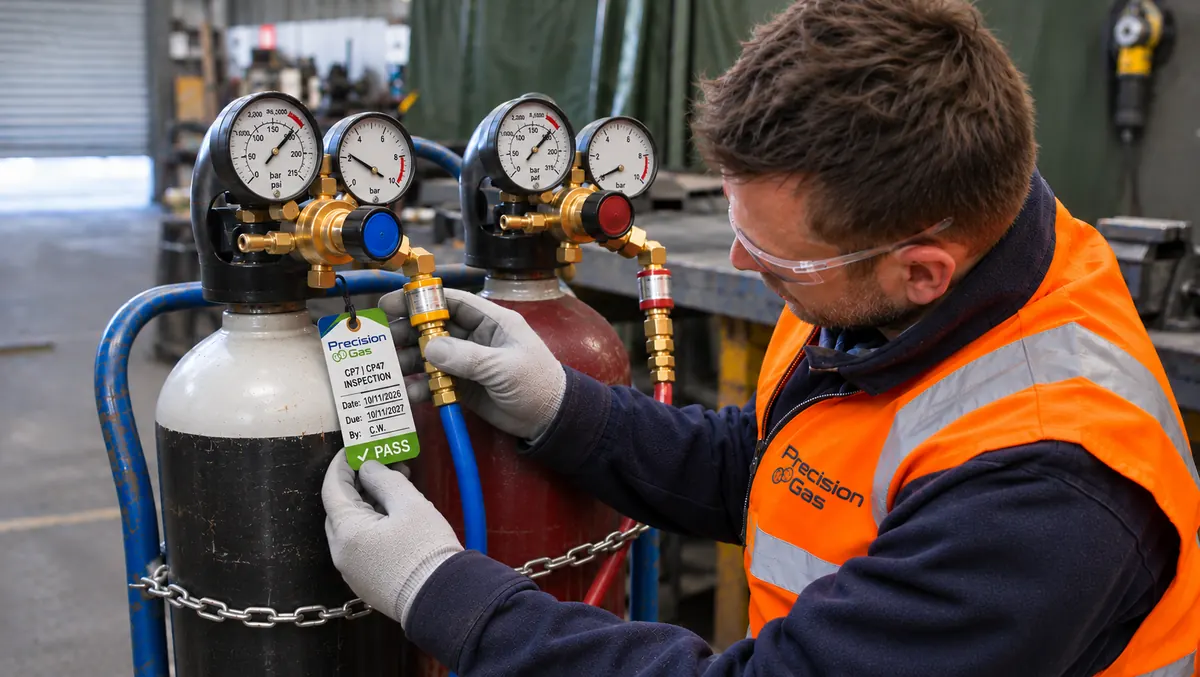
What is a CP7 inspection?
BCGA Code of Practice 7 (CP7) covers the safe use of oxy-fuel gas equipment: the welding, cutting, brazing and heating sets found in workshops, fabrication shops and on site. A CP7 inspection checks every part of that equipment, from the cylinder to the torch.
BCGA Code of Practice 47 (CP47) covers the wider range of portable and mobile cylinder gas supply equipment, such as single-cylinder regulators and manifolds for inert, oxidising and fuel gases, and shielding gases for MIG and TIG welding.
Why you need it
The Provision and Use of Work Equipment Regulations 1998 (PUWER) require employers to keep work equipment maintained and safe, and to inspect it where it could deteriorate. CP7 and CP47 are the industry guidance on how to do that for gas equipment. Insurers and auditors increasingly ask to see inspection records.
A failed regulator or a missing flashback arrester can cause a flashback, fire or cylinder explosion. Regular inspection is the simplest way to prevent that and to show you have taken reasonable steps.
What we inspect
- Regulators, including the date of manufacture and replacement due date
- Flashback arresters and non-return valves
- Hoses, hose assemblies and connections
- Blowpipes, torches and nozzles
- Gauges and outlet connections
- Cylinder storage, trolleys, chains and workstation set-up
- Manifolds and changeover units (CP47)
- MIG and TIG shielding gas regulators and flowmeters
What you get
- Every item checked, leak tested and tagged as passed or failed
- Failed parts replaced on the day with your approval, or taken out of use
- An item-by-item inspection report
- A certificate of inspection for your records and insurer
- A reminder before your next inspection is due
Areas we cover
We provide CP7 & CP47 Gas Equipment Inspection from our offices in Glasgow and Darlington, across Glasgow, Edinburgh, Aberdeen and the North, Darlington and the North East, and the rest of the UK.
A clear report you can hand straight to your insurer.
Every item we inspect is listed with its result, any work done and its next due date. No jargon and no guesswork.
- Pass or fail for every item
- Repairs and replacements recorded
- Certificate of inspection for audits and insurers
- A reminder from us before anything falls due
| Item | Result | Next due |
|---|---|---|
| Oxygen regulator, bay 2 | Pass | 12 months |
| Acetylene flashback arrester | Replaced | 12 months |
| Hose assembly, 5 m twin | Pass | 12 months |
| Argon manifold, 2-cylinder | Pass | 12 months |
| Cutting torch and nozzle | Pass | 12 months |
CP7 & CP47 Gas Equipment Inspection: common questions
How often should gas equipment be inspected under CP7?
At least once a year is the usual standard, and more often where equipment is used heavily or in harsh conditions. Your risk assessment sets the interval, and we can advise on what suits your site.
Do regulators need replacing if they still work?
Yes, they can. BCGA guidance gives regulators a recommended service life from their date of manufacture, typically five years. We check the date on every regulator and tell you which are due or nearly due.
What is the difference between CP7 and CP47?
CP7 covers oxy-fuel equipment such as welding and cutting sets. CP47 covers portable and mobile cylinder gas supply equipment more generally, such as single-cylinder regulators and manifolds. Most workshops need both.
Can you inspect on site?
Yes. We come to your site and work through equipment area by area, so most workshops keep running while we inspect.
Is a CP7 inspection a legal requirement?
CP7 itself is industry guidance rather than law. The legal duty comes from the Provision and Use of Work Equipment Regulations 1998 (PUWER), which require you to maintain and inspect work equipment. Following CP7 and CP47 is the recognised way to show you have met that duty, and it is what insurers and HSE inspectors expect to see.
What happens if an item fails?
It is tagged as failed and taken out of use so nobody uses it by mistake. We tell you what needs repairing or replacing and quote for it. Where we have the right part with us, we can replace it on the day with your approval.
How long does an inspection take?
It depends on how much equipment you have. A workshop with a few welding sets usually takes a few hours, while larger sites can take a day or more. We give you an estimate with your quote.
How is the work priced?
We give you a fixed quote based on how much equipment you have and the size of your site, so you know the cost before we start.
Do you provide RAMS and follow our site rules?
Yes. We provide risk assessments and method statements (RAMS) before work starts, and we follow your site's induction, permit-to-work and safety rules.
Get a quote: CP7 & CP47 Gas Equipment Inspection
Call, email or send the form and we'll come back to you with a quote.
Glasgow G2 1BP
Dodsworth Street
Darlington DL1 2NG